Offbeat Oregon decorative banner

PORTLAND, MULTNOMAH COUNTY; 1890s:

Portland was shanghaiing capital of world in 1890s

By Finn J.D. John
November 9, 2025

AS OF THE time of this writing, there is some disagreement over the status of Oregon’s largest city. It all came to a head last month when the President of the United States referred to it as “war-ravaged Portland” in a Tweet, and locals responded by going on Amazon and buying every inflatable frog costume they could get their hands on.

Interesting times, indeed!

A little over 100 years ago, though, you could have made the case that parts of Portland were — not war-ravaged, exactly, but probably the most dangerous city in North America in which to go out drinking.

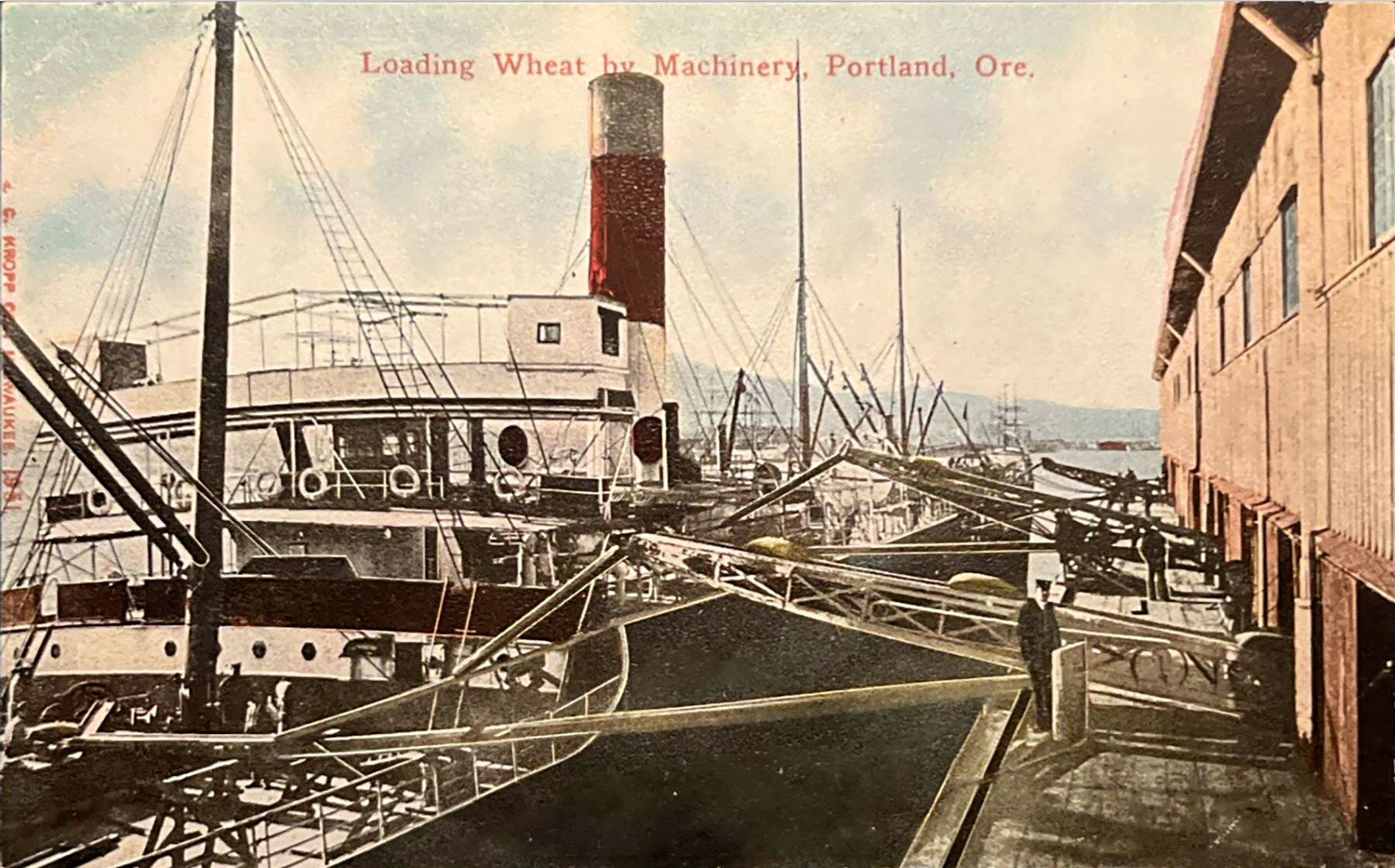
This postcard image, dating from around 1915, shows a cargo ship being loaded with wheat at the Port of Portland. This was shortly after the "golden age of crimping," as evidenced by the fact that the vessel is steam powered. (Image: Postcard)

But the risk you ran wasn’t getting killed, injured, or — uh, ravaged. It was the risk of waking up the next morning with a splitting headache and a bad case of seasickness, on board a barque headed for Liverpool. With an angry first mate screaming at you to get up and get to work and probably giving you a few kicks in the ribs to drive the point home that, whatever you thought your occupation was last night, this morning you were a sailor.

The last thing you likely would have remembered would have been a friendly stranger who chatted you up at a Portland waterfront bar … and bought you a drink.


NOT MANY PEOPLE know it, but at the end of the 1800s, Portland was the most notorious city in the western hemisphere for the practice known as “crimping,” the most lawless form of which was called “shanghaiing.”

Let me just demonstrate how crimping worked with an illustrative story:

Let’s say it’s 1893. A sailing ship has just come into port, part of the British grain fleet that used to regularly call in Portland to trade for Willamette Valley and Umatilla Basin grain. Let’s call it, with a nod to legendary historio-fabulist Stewart Holbrook, The Flying Prince.

The Flying Prince is, let’s say, a sister ship to the Peter Iredale — an iron-hulled four-masted bark, 285 feet long and 2,100 tons. She’s based out of Liverpool, as are most of the sailors aboard her, and, after unloading her ballast and taking on 275,000 bushels of Oregon wheat, she’ll be sailing back to Liverpool, with brief stops along the way to replenish water casks and other provisions. The voyage will take many months.

The sailors have been at sea for 11 months already, and their salary is about $30 a month, so they’re comparatively rich men; but they sure don’t feel very rich, because they won’t be paid any of the wages they’ve earned until after the journey is complete and the ship is back home in Liverpool. To incentivize the crew against desertion, it’s the shipping company’s policy to not pay the men their wages until they are safely back on British soil, at which time the Flying Prince’s captain will pay the crew members their wages for the entire journey in a lump sum.

So when the ship arrives in Portland, the sailors who make up her crew are essentially penniless; although they’ve earned the equivalent of about $10,000 in modern money for their salary on the journey, they won’t see any of that until they’re back in Liverpool.

Back to our story. As the Flying Prince glides toward the wharf, a flotilla of several little Whitehall skiffs leave the pier and are rowed out to meet the incoming ship. The occupants of these rowboats are what’s known as “boardinghouse runners” — basically, outside-sales representatives of the several different sailors’ boardinghouses along the waterfront.

The runners’ job is to convince as many sailors as they can to come stay in their boss’s boardinghouse. Upon arrival, they clamber aboard, pass out bottles and cigars, and talk to all the sailors about how wonderful their boss’s boardinghouse is, and what a palmy paradise of ease and refreshment awaits the weary traveler there, and how much more pleasant it will be to spend the next few days there rather than staying in the squalid, stinky forecastle in which they’ve been forced to spend the previous months at sea.

It’s never hard to sell the sailors, especially the younger and more naïve ones, on the idea of getting off the ship — especially when they learn (if they don’t already know) that the boardinghouse rent is all “on credit.” That is, they can stay there as long as they need to until their ship is unloaded and ready to sail out again, eating and drinking their fill and relaxing with friends old and new, until it was time to go to sea again, and the “boarding master” (also known as a “crimp”) would be paid for their rent by the captain of their ship as an advance against their wages at sea.

And this is pretty important, since the sailors are all dead stony broke and will be until they get home to Liverpool. So even if they want to pay as they go, or maybe check into a nicer place, or purchase some friendly company in a bordello or sporting-house for the night — they can’t. Their choices are, either stay on the ship, or check into a sailor’s boardinghouse. Most of them go for the boardinghouse.

A week or two goes by as the burly longshoremen trudge in and out of the Flying Prince, filling its cargo hold with good Umatilla wheat. Finally, she’s full, and ready to be on her way across the bar and on her way back home to Old Blighty.

But, most of the sailors in the boardinghouse aren’t there to take their places. No sailor ever wants to go to sea any sooner than he has to. On shore, the food is better, there is no cold hard work to do, and a fellow is far less likely to end up in a watery grave. Now, it’s time to get back; but nobody is forcing the Flying Prince’s crew to turn up and work — so they aren’t. They’re sticking around the boardinghouse and awaiting developments.

So the captain of the ship has a couple of options. He can try to drag his sailors back to the ship; but he’ll have a hard time finding them, as it’s in the boarding master’s best interests to help them avoid recapture (more on that in a minute).

Or, the captain can basically purchase the services of replacement sailors from the same crimp who runs the boardinghouse in which his sailors are hiding out.

The process of purchasing a sailor is pretty straightforward. The crimp presents a bill for the sailor’s room and board for the time he has been in the boardinghouse. In addition, there’s a “finder’s fee” that’s usually $20 to $50, depending on market conditions, which the sailors call “blood money.”

This money changes hands, and then the boarding master goes and gets the sailor he’s “sold” and delivers him to the ship. As you can imagine, the process of doing this often requires some judicious application of physical persuasion; so boarding masters usually are either trained prizefighters or experienced brawlers.

In our illustrative story, the crimp sells the captain the services of 11 of the sailors who arrived in port the week before, on the German barque Burgermeister Meister-Burger, collecting a blood-money premium of $50 each for delivering them. And the sailors who arrived on the Flying Prince watch happily as their old ship stands out across the bar and away for the 11-month journey back to Old Blighty without them.


[EDITOR'S NOTE:
In "reader view" some phone browsers truncate the story here, algorithmically "assuming" that the second column is advertising. (Most browsers do not recognize this page as mobile-device-friendly; it is designed to be browsed on any device without reflowing, by taking advantage of the "double-tap-to-zoom" function.) If the story ends here on your device, you may have to exit "reader view" (sometimes labeled "Make This Page Mobile Friendly Mode") to continue reading. We apologize for the inconvenience.]

(Jump to top of next column)

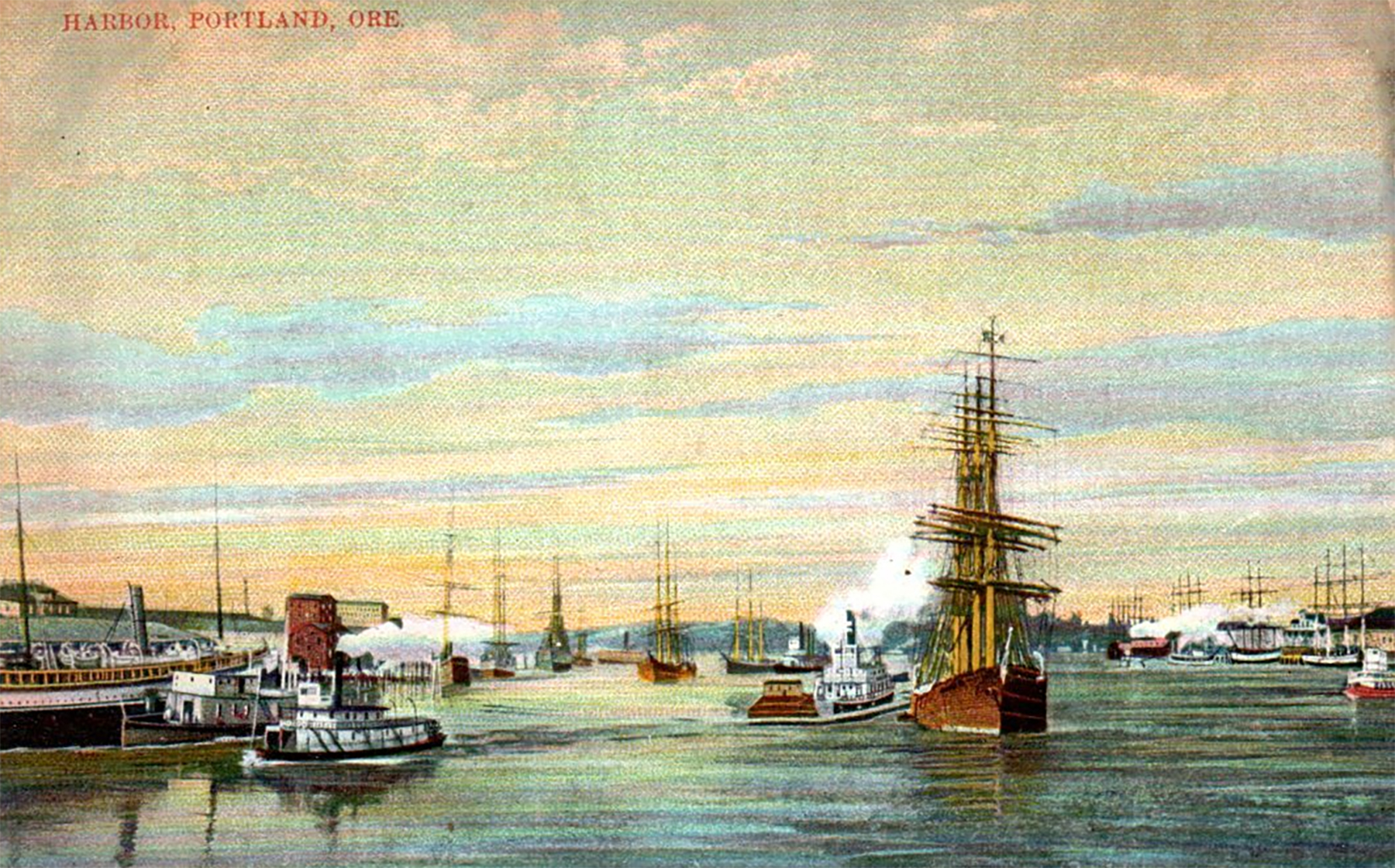
This colorized postcard image is of Portland's harbor very early in the 20th century. (Image: Postcard)


Now, you would think the captain of the Flying Prince would be beside himself with rage at having to pay all this blood money to replace all these truant sailors. He is not. He is delighted. You see, all those sailors who stayed behind are now technically deserters. As such, they have forfeited all the pay that they’ve accumulated on the voyage from Liverpool. In the 1890s, sailors earn roughly $30 a month, and they’ve been at sea for 11 months so far; so that’s $330 per deserter that the captain just gets to keep. He doesn’t in the least mind even a heavy “blood money” expense, plus another dozen or two dollars in room and board, when he’s got three C-notes and change in abandoned wages to offset it with.

A few weeks go by. Our sailors from the Flying Prince have settled into their life of ease in the boardinghouse. Let’s follow one of them, a young tar named Jack Pringle. Jack has just finished his supper — a thin, moderately grim stew that is nonetheless princely fare compared with what he gets at sea, with bread to dip in it — when the boarding master, Larry Sullivan, steps up beside him.

“Jack, my boy, it’s time for you to go back to sea,” says Larry affably. “It’s been great having you here, but all good things must end sometime. The Sea Witch is weighing anchor at dawn, and I need you to join her crew.”

“Oh, I can’t sail now!” Jack cries in dismay. “Give me another week, I’ll walk right down and sign on for the next one. And isn’t the Sea Witch old Bully Waterman’s ship? I want nothing to do with that brute.”

Larry surreptitiously eyes Jack, sizing him up. He’s a six-footer, untrained but capable of doing some damage in a fight, if nothing else by falling on him. Larry, a former prizefighter, knows he can force Jack to the ship, but he might pick up a shiner or lose a tooth. It’s not worth it.

“Ah well,” Larry says, clapping Jack on the shoulder. “We’ll get you on the next one, times aren’t so hard just now. Come, let’s have a drink together. I won’t even put it on your bill.”

The sailor and the crimp stroll up to the little house bar, and Jack watches as two tumblers are poured half full of rum, one for him and one for Larry. But he notices one of the tumblers has a little pile of powder in the bottom. This isn’t his first rodeo, and he knows what that means.

“Hey!” he shouts, then stops. Larry has a pistol out and pointed straight at him.

“Pick it up and drink it,” Larry orders.

Jack does, and the next thing he knows he’s waking up in a berth in the forecastle of the Sea Witch.


SO THAT’S CRIMPING — essentially a human-trafficking operation using forced indebtedness to keep the sailors trapped in the loop while boarding masters and corrupt ship captains swindle them out of their wages.

Shanghaiing is essentially freelance crimping. When the boardinghouse is empty of sailors who can be forced to go to sea to pay their room and board, the boarding masters (and other freelancers) just go out on the town, prowling for some naïve plowboy or incautious logger whom they can strike up a temporary friendship with.

Most often, that friendship would end at a bar, at which point the boarding master would dope his new friend’s drink (or the bartender would, on the boarding master’s orders).

It’s impossible to tell the difference between a sailor who’s passed out after having too much to drink, and a drugged shanghaiing victim, when his “shipmate” is helping him get back to his berth on the ship. On a Saturday night, in waterfront Portland circa 1895, lots of both kinds of unconscious men were being conveyed to the forecastles of grain-fleet ships by helpful-looking lads. Some were fellow sailors, helping their shipmates; some were shanghaiers … helping themselves.

By the way, shanghaiers almost never used blackjacks or saps, like they do in the movies. It’s just too hard to clobber a man with just the right amount of force. Too much, and you lose your blood-money prize and are at serious risk of a murder rap; too little, and you’ve got a bad fight on your hands against a very angry opponent. Drugs were mostly used; there’s also some anecdotal evidence that some taverns were rigged like mousetraps to catch sailors as well. There also is anecdotal evidence that there were basement cells used to keep shanghaiing victims “on ice” until shortly before a ship’s departure time, when the captured sailor would be forced to take a drug at gunpoint and, again, wake up aboard ship.


AS THE 1890s ripened into the nineteen-oughts, the Portland shanghaiing scene shifted. For one thing, master shanghaier Larry Sullivan figured out how to cut the captains out of the deal by pulling strings to get the sailors arrested for petty crimes just before sailing time, so that they would be stuck in jail when the ships sailed. When that happened, the captains had to leave the sailor’s pay behind for him, since he wasn’t technically deserting. This resulted in international incidents and sanctions against the Port of Portland, all of which are more than we have time to delve into here.

Throughout, the crimping and shanghaiing scene marched on. If anything, it got worse as the years went by.

“I will state that there is one port on the Pacific coast that has always been known as the greatest crimping den in America,” Andrew Furuseth, president of the International Seamen’s Union of America, testified to the U.S. House of Representatives in 1911. “I refer to the port of Portland.”


THE ”GLORY DAYS” of crimping in Portland ended not with a bang, but with a whimper. By 1915, when the federal government passed the relatively toothless Seaman’s Act, the practice was mostly history anyway. The Grain Fleet had switched over almost entirely to steamships, which were a lot more pleasant to live on; plus, any mariner who had a berth on a steamer was loath to risk leaving it and checking into a boardinghouse, lest he miss his sailing and end up crimped back onto one of the remaining sail-powered ships.

As for shanghaiing … it was well known among hoboes and tramps in the 1920s and into the 1930s that one had to be very careful near the waterfront. The last sail-powered freighter wasn’t built until the late 1920s, so they were still around; somebody had to crew them, and nobody wanted to.

But for the most part, shanghaiing was a dying art by 1920.


(Sources: Portland’s Lost Waterfront, a book by Barney Blalock published in 2012 by The History Press; “Grain, Flour and Ships,” a report prepared by George Kramer published online by Proper Portland in 2019; Shanghaiing Days, a book by Richard Dillon published in 1961 by Coward-McCann)


Looking for more?

Here are some quick links for your convenience!

Directory of Articles, 2008-present:

On our Sortable Master Directory you can search by keywords, locations, or historical timeframes.

Daily podcast:

Each weekday, an Offbeat Oregon article goes up on our podcast in audio form. Each episode is a column like the one on this page, read for you by Finn J.D. John, and runs about 10 minutes.

On Apple Podcasts

On Spotify


Listeners

.
Background image is a postcard, a hand-tinted photograph of Crown Point and the Columbia Gorge Scenic Highway. Here is a link to the Offbeat Oregon article about it, from 2024.
Scroll sideways to move the article aside for a better view.

©2008-2025 by Finn J.D. John. Copyright assertion does not apply to assets that are in the public domain or are used by permission.