Offbeat Oregon decorative banner

STATEWIDE; 1930s:

WPA writers captured a snapshot of early Oregon

By Finn J.D. John
September 14, 2025

IN 1935, IN the depths of the Great Depression, the U.S. Congress passed what’s sometimes called the “Second New Deal.” It was a $4.88 billion investment into getting Americans through the Depression.

The original New Deal, launched in 1933 just after Franklin Roosevelt won the Presidency, had prevented people from starving in the streets; but Roosevelt agreed with some of his critics who felt giving able-bodied working people dole money was demoralizing and demeaning. The 1935 Emergency Relief Appropriation Act tried to fix that by pivoting away from direct dole payments for people who could work, instead launching projects that could employ the unemployed in their own lines of work.

The philosophy behind this new New Deal push was to let unemployed workers earn their way by putting their existing skills to use, rather than treating them like charity cases or giving them make-work jobs raking leaves or doing litter patrols.

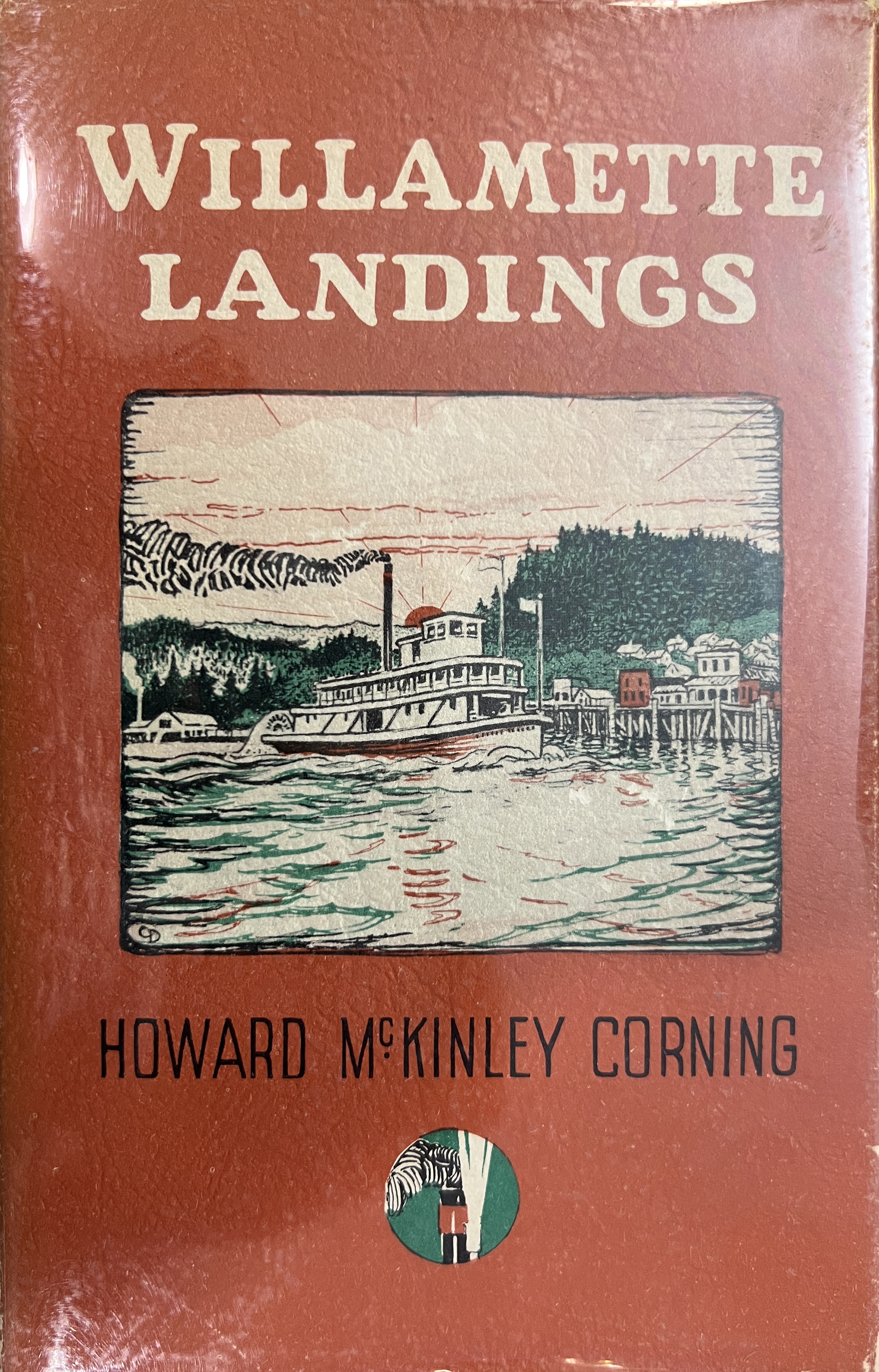
The front cover of Howard McKinley Corning’s guidebook, Willamette Landings: Ghost Towns of the River, which he wrote as part of the WPA Federal Writers’ Project. It was not yet published when the war ended things, so it wasn’t published until 1947 when the Oregon Historical Society took the manuscript in hand. (Image: Binfords and Mort Publishers)

It’s an idea that never worked perfectly; but it worked far better than anything else that has been tried, before or since. Professionals and highly skilled workers especially found receiving dole payments profoundly demoralizing and, of course, the government got nothing out of it. Bestowing huge taxpayer-funded gifts upon giant corporations in hopes that they will use the money to employ more people (rather than paying out bonuses to their executives or buying back stock shares) is, if recent experience is any guide, an even worse idea; at least workers receiving a dole payment can be depended on to use it to buy things.

But maybe the best benefit of this “put ’em to work building stuff for the future” approach is, we all got something out of it. Projects like Timberline Lodge, the improvements at Silver Falls State Park, and the Dee Wright Observatory are still around and in use today, and skilled craftsmen proudly brought their best work to the job despite being paid pennies on every dollar their talents would command during more normal times.

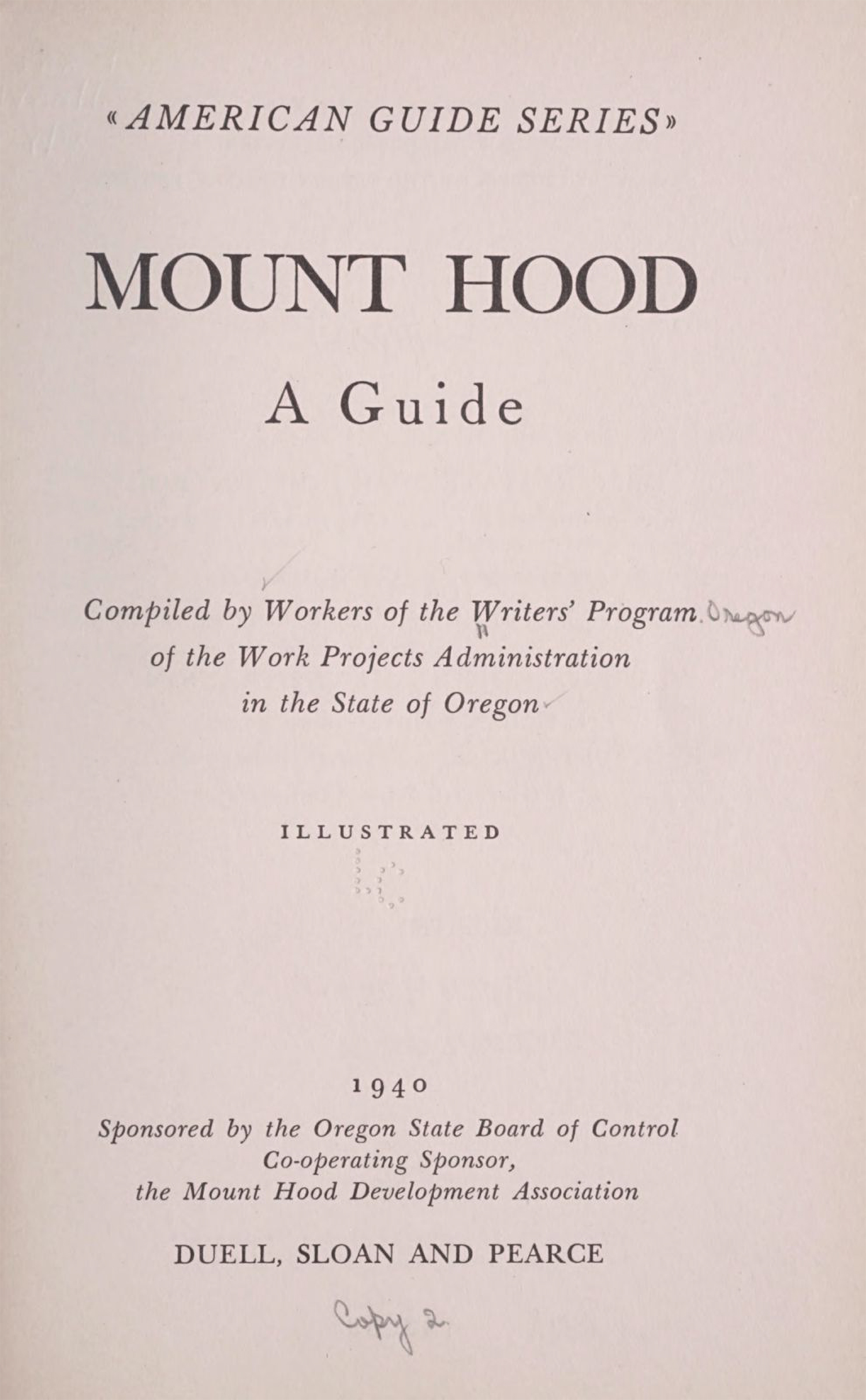
The title page of the Federal Writers’ Project historical publication on Mount Hood, written by the Oregon WPA staff. (Image: Library of Congress)

One category of skilled workers who are often unemployed during hard times is writers and artists. So a comparatively tiny sliver of the WPA’s funds went toward “Federal Project Number One,” a group that included the Federal Writers’ Project, Federal Art Project, Federal Music Project, and Federal Theatre Project.

In Oregon, the Federal Writers’ Project was especially interesting, because in 1938 — when most of its work was done — there were actual Oregon Trail pioneers still alive.

The WPA set up an office in Portland, and staffed it with a roster of top-flight writers who had been temporarily embarrassed by the Depression. Sara B. Wrenn, Andrew Sherbert, Clair Churchill, Walker Winslow, and William Haight were frequent contributors, and each brought their own particular flair to the job. Their stories fell into six formal categories: Agriculture, Folklore, Occupations, Transportation systems, Recreational Opportunities, and Ethnic Groups.

The basic operating plan was for the writers to find an interesting person and conduct an oral history with him or her. Writers went to various places in the country and recorded on paper the stories of particularly interesting, colorful and/or elderly citizens.

In addition to these oral-history interviews, there also were travel guides, song lyrics, educational materials for schoolkids, and a free annual “Oregon Almanac.” They also produced radio programs and research guides to county archives.

The project hit some rough headwinds toward the end, as political pressure mounted. Lots of conservative politicians considered such projects as make-work boondoggles, and as rumors of Soviet Russia’s infiltration of the American intellectual world in the 1930s started increasing in intensity and believability, the House Un-American Activities Committee got involved. The project’s national leader was fired in 1939, and then of course when the Second World War broke out it was basically abandoned on the spot.

Because of the war, there was never really a proper winding-down of the WPA writers’ project. Boxes and boxes were simply filled with the work and placed in storage. To this day, what’s publicly available is a sliver of their total output.

It's a bigger sliver than it was before 1999, though, in Oregon at least. That’s when librarians at the State of Oregon Library, cleaning up after a flood, stumbled across several boxes crammed with thousands of pages of Writers’ Project files. Scholars Tom Nash, Twilo Scofield and Nancy Appling Salucci volunteered to go through them, photocopying old yellowing typescripts on new acid-free paper and compiling an index to the contents.

These are all available at the state library today. A few of them have been digitized and can be browsed on line at the library’s Digital Collections Website. In addition, a collection of 100 or so have been digitized by the Library of Congress and can be browsed on line.

The Folklore Studies manuscripts may be the most interesting of the lot, from a storytelling standpoint. The story in the sidebar to this article is a great example, albeit one cherry-picked by Yours Truly for maximum entertainment value. But, there is lots more where it came from.


IN THE FINAL analysis, anyone with half a day to spend getting reacquainted with old Oregon as it existed in the pre-war years can benefit from the work of these old-time folklorists and history writers.

A simple search for “Oregon WPA” at the Library of Congress’s Website will bring up nearly 30,000 items, mostly newspapers and books; but if you click the “Manuscripts/ Mixed Material” link at the left side of the page, you can browse through 118 of these articles written by the WPA writers in the late 1930s; and another 40 or 50 more have been miscategorized as “Books,” so you can find them there as well.


[EDITOR'S NOTE:
In "reader view" some phone browsers truncate the story here, algorithmically "assuming" that the second column is advertising. (Most browsers do not recognize this page as mobile-device-friendly; it is designed to be browsed on any device without reflowing, by taking advantage of the "double-tap-to-zoom" function.) If the story ends here on your device, you may have to exit "reader view" (sometimes labeled "Make This Page Mobile Friendly Mode") to continue reading. We apologize for the inconvenience.]

(Jump to top of next column)

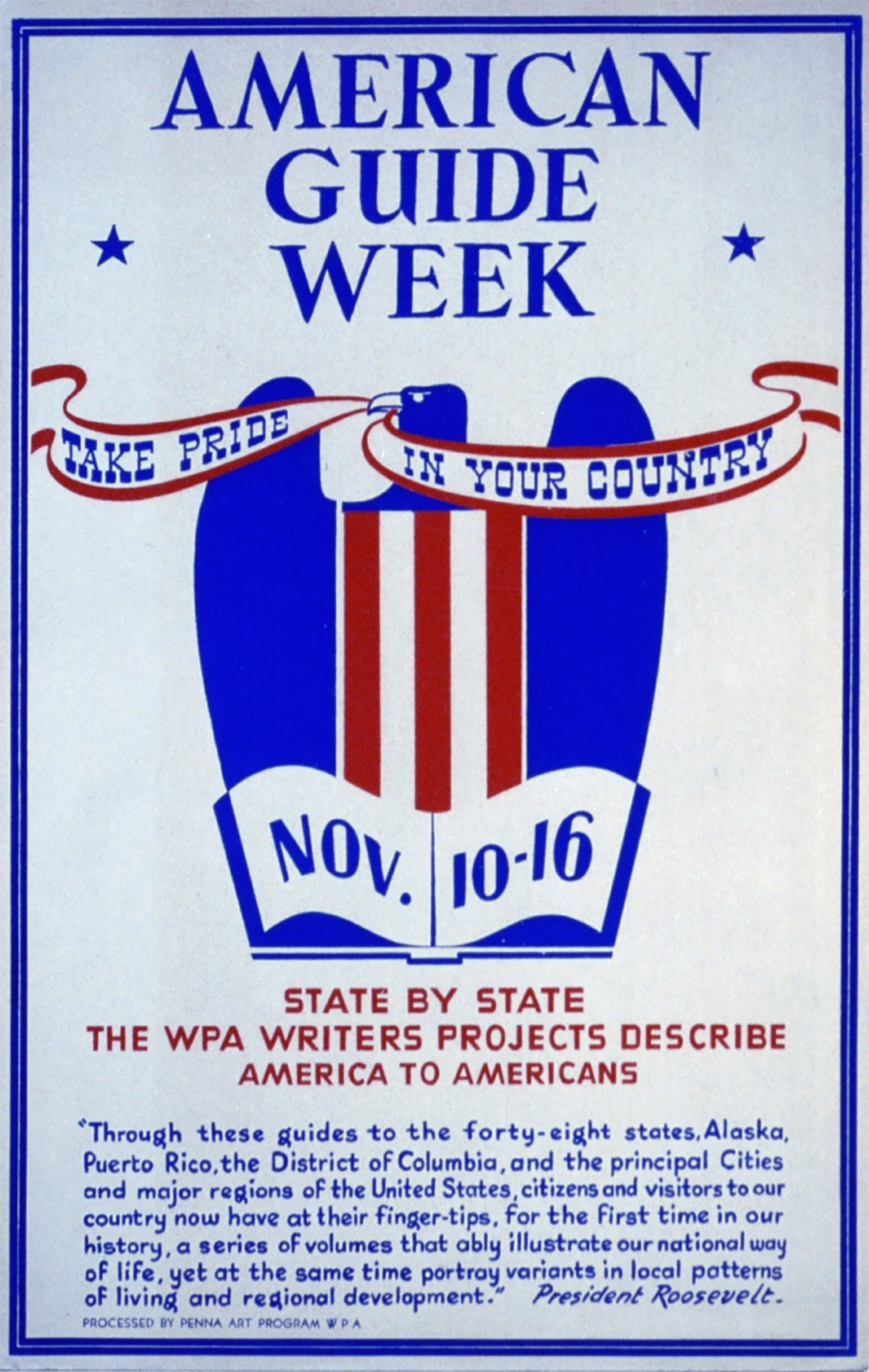
A poster created by the Federal Writers Project in 1941, promoting the “American Guide” projects. (Image: Library of Congress)


It’s a drop in the bucket, really; but the color and character of old Oregon shines through in them, and who knows — they may whet your appetite for more!

The Maddest Man in Town:

What follows is an interview transcript by William Haight with Charles Imus of 1624 SW 16th St., Portland, conducted Feb. 24, 1939. Charley, 59, was a retired farm worker, logger, livery stable keeper and dance hall manager … and, as we shall hear, an undertaker’s son. The story he tells would have taken place in the late 1880s.

Are ya religious? If ya are I won’t tell this story. Awright, I guess it won’t hurt ya none to hear it. It’s about old man Donovan. He was as good a Catholic as I ever knew, until he got mad once. Then he was mad for 17 years — the maddest man in town. Ye-up, ding-blasted mad and powerful mizzur’ble. Considering all in all, I reckon his being mad so long set a record of sorts for the whole danged county.

You’re right, the old duffer was an Irishman. Being Irish, it didn’t take much to start his blood a-boilin’. A kinda small man, inclined to be delicate, with long gray whiskers and a sizable mustache, he was quite a Indian on the warpath. His long grey chin whiskers would wave in the air sorta like they was fannin’ the cuss words to take the heat offa them as they came out.

Well, among other things he had two kids, Harry and Joe. Harry was the little bugger and Joe was the big one. Joe was might’ nigh six-four. Joe bein’ so tall and me bein’ considerable shorter didn’t no way affect our fightin’ nearly every day at school. I reckon that was mainly why I went — so I could wallop Joe up; an’ then get walloped up by Joe. We both seemed to like it.

One day I went to school prepared to give Joe a walloping, since he’d done walloped me the day before. But Joe wasn’t there. Right away, I figgered somethin’ mighty durned important musta’ happened to keep Joe from coming to school that day.

Sure ’nuff, school hadn’t been took up more’n a little while when somebody came by and told us old man Donovan had died. Soon’s the teacher heard this she dismissed school. Seems like the widow Donovan was a-needin’ some help at the house, so the teacher asked my side-kick, Bill, the long ’un, and me to go up there. Seein’ as how my old man was the undertaker and had already loaned her the money to send for the priest to come and pray Donovan out of purgatory, I guess the teacher thought I was the one to send. Bill allus went where I did, him and me bein’ the long an’ short of it, as folks’d say.

Mrs. Donovan had to send to Vancouver for a priest, and the fellow that come was purty old and mighty set in his ways. I reckon he figgered he was close to God and didn’t mind to allow he knew purty near as much.

And he did his job all right. After he got settled he put on all his robes and started to work. Him and Dad laid Donovan out on a board supported by two chairs, threw a sheet over him and put the required number of candles at his head and feet. Then the priest prayed and sprinkled water, and prayed and sprinkled water some more, till old man Donovan was prayed and sprayed out of purgatory. Soon’s the priest left, Bill and me was delegated to sit in the kitchen and watch the corpse, which was in the next room.

Donovan, bein’ an Irishman, his passin’ naturally allowed for a wake. So every Irishman and German within forty miles came to set up for the night. The Germans in our part was not much on wakin’ the dead, but because they was mighty thick with the Irish they was willing to help the Irish wake their dead ’uns. All foreigners in them days stuck purty close together, ya know. These wakers set around in another room with the family, and were a-passin’ a sociable evenin’. Most of ’em were drinkin’ out of a couple of demijohns I saw on the table when some Irishman stuck his head out the door to see if Donovan was a-lyin’ out right. The rest of the people were a-playin’ cards and talkin’ to the widow. Seems as though they’d drink, play cards awhile, then the widow’d wail a bit.

Me and Bill, bein’ too young to wake, had to pass the time tryin’ to read in the kitchen. This was kinda hard to do. The house was built on a hill, almost the crest, causin’ the shakes to catch all the wind. That old wind would howl a mighty bit when she’d hit the shakes. The wind a-howlin’, coupled with the wail of the wakers, sort of discommoded Bill and me. Bill was plenty scairt anyhow, Donovan was the first corpse he’d ever been around.

So’s all that howlin’ had Bill a-settin’ mighty uncomfortable-like in his chair, and kept me kinda on the uneasy side.

All of a sudden Bill and me heard the consarndest noise I’ve ever heard, or expect to hear. Bill jumped from his chair scairt-like and says, kind of quavery like, “What’s that?” By this time I’m a-standin’ on my feet and a-listenin’. Sure nuff! ’Tweren’t the wind nor the wakers — the sound was a-comin’ from that corpse.

Now, Bill, not a-takin’ his job none too good no ways, decided he wanted to leave. “Shucks,” I says to Bill, tryin’ to calm him, “it’s probably the cat.” God! I thought that was terrible. Here them wakers were a-dependin’ on Bill and me to watch the corpse and we’d done let the cat in! I told Bill to be real quiet like and we wouldn’t disturb nothin’, and to bring the metal plated lamp along so’s we could see.

Bill and me sort of crept into the room. Soon’s the light hit that corpse we could see the sheet a goin’ up and down, up and down, with the awfullest noise a-comin’ out from under it. Bill takes a good look, tries hand me the rattlin’ lamp, shakin’ his hands, and says, “By God, I’m a-gettin’ out of here!”

He shoves the lamp in my hand and runs like a scairt [racial slur] for home. I figgers him bein’ so much bigger’n me, there’s a lot more of him scairt than there is of me, so I goes up closer.

For a spell I watched, Then I goes over and gingerly lifts up the sheet, sort of expectin’ to see the cat. By that time some of the wakers heard the noise and came edging in to see what it was all about.

Well, I’ll be ding-blasted if old man Donovan wasn’t a-breathin’. Yes sir, the old coot was as alive as you or me right now. That peculiar noise we’d been hearin’ under the sheet was him a-breathin’. Right away the fellers picked him up and toted him into the bedroom. They wrapped warm blankets round him and nursed him back to full breath. Purty soon he took a pull at the demijohn hisself. And was his wife happy! Everybody was real excited.

In a few days Donovan was out on the streets again, a well man. He lived for 17 years more.

And here’s what made him mad all that time:

The priest, bein’ mighty set in his ways, wouldn’t let Donovan nor his family go to church no more. He figgered Donovan had pulled the trick of playin’ possum on him. And even if he hadn’t it looked like God thought the old cuss was such a sinner that he had to be sent back to earth. Anyway, the priest said he had prayed old Donovan out of purgatory and now he was beyond the jurisdiction of the Church.

Mad? I reckon there never was a madder Irishman than old man Donovan.

You could just see it boiling out of him as he walked down the street. If you wanted to see them chin whiskers of his fan the air, you only had to mention purgatory or the priest to him. His old lady got to swearin’ like a trooper, and between the two of ’em I guess they really told the priest off.

Ye-up. Donovan stayed mad for 17 years. Maybe he still is, I don’t profess to know. A freight train finally put an end to his mortal life; it took that to kill him. But he had to die sometime.

 

(Sources: “Federal Writers’ Project in Oregon,” an article by Tom Nash published Aug. 26, 2022, in The Oregon Encyclopedia; State of Oregon Library digital collections; Library of Congress digital collections)


Looking for more?

Here are some quick links for your convenience!

Directory of Articles, 2008-present:

On our Sortable Master Directory you can search by keywords, locations, or historical timeframes.

Daily podcast:

Each weekday, an Offbeat Oregon article goes up on our podcast in audio form. Each episode is a column like the one on this page, read for you by Finn J.D. John, and runs about 10 minutes.

On Apple Podcasts

On Spotify


Listeners

.
Background image is a postcard, a hand-tinted photograph of Crown Point and the Columbia Gorge Scenic Highway. Here is a link to the Offbeat Oregon article about it, from 2024.
Scroll sideways to move the article aside for a better view.

©2008-2025 by Finn J.D. John. Copyright assertion does not apply to assets that are in the public domain or are used by permission.